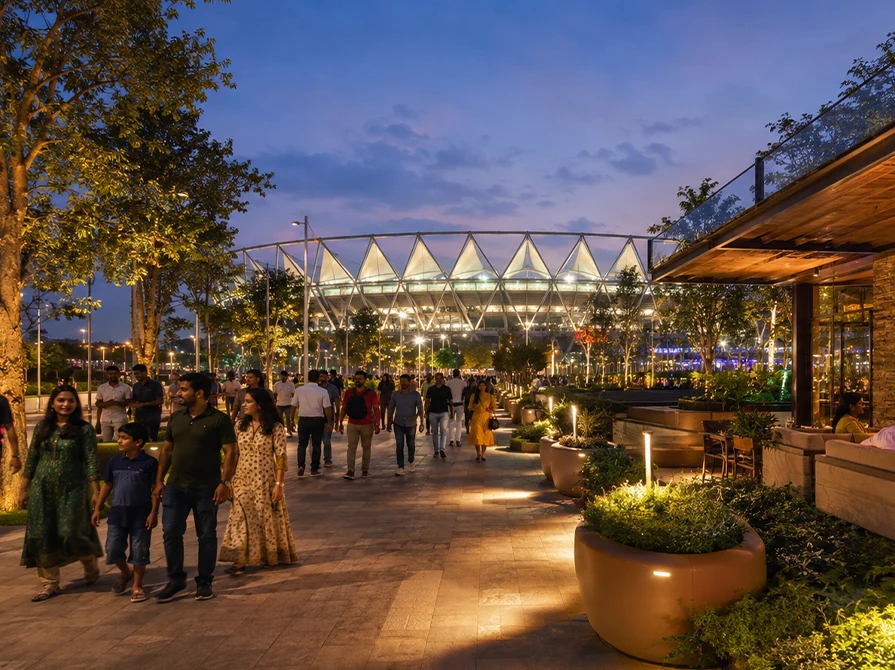


Imagine approaching a hotel, office building, or housing society after sunset. Before you enter the property, you see the entrance, facade, covered walkway, boundary wall, and surrounding pathways. The outdoor wall lights across these spaces shape the visual experience and help you navigate the property safely.
Outdoor wall lights are among the most versatile fixtures used in commercial building lighting. They can provide functional illumination, highlight architectural features, support security, and create a consistent visual identity across a property.
Choosing the right fixture requires consideration of the application, mounting height, beam angle, colour temperature, IP and IK ratings, lumen output, and control requirements. This guide explains the main types of outdoor wall lights, where to place them, and what to check before buying them for a commercial property in India.
Outdoor wall lights are lighting fixtures mounted on exterior walls, columns, boundary walls, building facades, covered walkways, and canopies. They provide functional illumination while contributing to the aesthetics, safety, security, and wayfinding of a building's exterior.
They are available in several formats, including up-down lights, wall washers, surface-mounted fixtures, linear profile lights, decorative fixtures, and outdoor ceiling lights. These fixtures are used across offices, hotels, hospitals, educational campuses, housing societies, retail properties, and industrial facilities.
Up-down lights are wall-mounted fixtures that emit light in both upward and downward directions. They create a layered lighting effect on exterior walls while providing useful illumination around entrances, pathways, and boundaries.
They are widely used at hotel entrances, office facades, housing society boundary walls, covered walkways, and building perimeters. They can also highlight architectural textures and create visual rhythm when installed at regular intervals.
Wall washers are designed to distribute light broadly and evenly across a wall surface. They work well for large facade panels, reception-area exteriors, boundary walls, and architectural surfaces where consistent illumination is required.
Wide beam angles, often around 60° to 120°, can provide broad coverage. Throw distance is another important consideration because it determines how effectively the fixture illuminates the intended surface.
Wall washers are particularly useful when the objective is to create an even layer of light across a large facade.
Surface-mounted wall lights are compact fixtures installed directly on exterior walls, columns, stairwells, covered parking areas, corridors, and building entrances.
They are available in round, square, rectangular, and linear designs. Their compact form makes them suitable for locations where the fixture needs to integrate neatly with the architecture.
Outdoor ceiling lights are installed on covered soffits, canopies, entrance overhangs, basement parking ceilings, and covered walkways. They can provide consistent illumination across entrance and circulation areas while integrating neatly with the building structure.
Depending on exposure, IP54 to IP65 protection may be suitable. Entrance areas monitored by CCTV can benefit from CRI 80+ lighting for clear colour reproduction.
Outdoor profile lights are linear LED fixtures installed horizontally or vertically along exterior walls. They can create continuous lines of light, emphasise floor plates, and define architectural edges.
Key specifications include IP65 protection, lumen output per metre, colour temperature, mounting method, and compatibility with dimming or smart lighting control systems.
Decorative wall lights are commonly used on heritage properties, boutique hotels, premium residential developments, educational institutions, and architectural buildings.
They are available in finishes such as brass, antique bronze, powder-coated aluminium, and other decorative materials. For Indian outdoor lighting applications, suitable weather protection is important. LED sources are generally preferred for their efficiency, operating life, and ease of control.
The placement of outdoor wall lights should be planned according to the function of each zone.
Entrances are high-priority areas because they combine wayfinding, security, and visitor experience. Up-down lights, surface-mounted fixtures, or statement wall lights can be positioned around doorways and entrance features.
A typical design target may be around 150 to 200 lux at the entrance face, depending on the application. Fixtures should be positioned to provide comfortable illumination without directing glare toward arriving visitors.
Wall washers and up-down lights can be distributed along facades to highlight architectural elements and create visual continuity.
For boundary-level up-down lights, mounting heights around 2.5 to 3.5 metres can work well depending on the wall design and fixture optics. Spacing should be determined through the desired light pattern and photometric calculations.
Soffit lights, canopy fixtures, and wall-mounted lights can provide illumination along pedestrian routes.
Around 50 to 100 lux can be considered as a general safety reference, while high-footfall areas may require around 150 to 200 lux depending on the application.
Wall-mounted fixtures can illuminate stairs, landings, ramps, and transition points. Emergency lighting should be integrated into required exit and evacuation routes so that essential illumination remains available during a power interruption.
Up-down lights and surface-mounted fixtures can combine security and architectural lighting along property boundaries.
A spacing of approximately 3 to 4 metres can be considered as an initial design reference, with final spacing determined by fixture output, mounting height, wall dimensions, and the required illumination.
For accessible, public-facing installations, IK08 or higher impact protection can be considered.
Surface-mounted fixtures on parking columns can provide consistent illumination across vehicular and pedestrian areas. Open parking areas may use around 100 to 150 lux, while covered or basement parking areas may require around 150 to 200 lux, depending on the application and applicable standards.
Basement ramps, covered corridors, and semi-outdoor spaces require fixtures suited to their exposure conditions. IP54 may suit protected locations, while IP65 provides additional protection where greater exposure is expected.
The required illuminance depends on the function of each area.
| Zone | Indicative average illuminance |
|---|---|
| Main entrance | 150 to 200 lux |
| Covered walkway | 50 to 100 lux |
| High-footfall walkway | 150 to 200 lux |
| Stairwell and ramp | Application dependent |
| Parking | 100 to 150 lux |
| Basement parking | 150 to 200 lux |
| Perimeter wall | Application dependent |
Colour temperature influences the visual character of an outdoor space.
Warm white creates a welcoming and premium appearance. It works well for hotels, boutique offices, heritage buildings, premium housing, and hospitality entrances.
Neutral white provides a clean and professional appearance. It is suitable for corporate offices, hospitals, educational institutions, and many commercial buildings.
Cool white provides a crisp appearance and strong visibility. It can be considered for security-focused areas, parking structures, industrial facilities, and commercial perimeters.
Colour temperature should be planned by zone. Mixing significantly different CCTs across the same wall or connected facade can create visual inconsistency.
Outdoor wall lights operate through India's varied weather conditions, including monsoons, heat, dust, humidity, and coastal exposure. The appropriate IP rating should therefore be a core part of the specification.
Smart controls can make outdoor wall lighting more efficient and easier to manage across large commercial properties.
Different zones can follow separate schedules. Entrance lights may operate for longer periods, while perimeter lighting can transition to lower output during late-night hours.
Sensors can adjust lighting in covered walkways, stairwells, parking structures, and other areas according to movement.
Dimming allows lighting levels to be adjusted according to footfall and operating hours while maintaining the required safety illumination.
Scene presets can create different settings for regular operation, special events, festive periods, and security requirements.
Connected systems can provide fixture status, fault alerts, and operational information through a central dashboard.
Outdoor wall lights can be integrated into a Building Management System to coordinate lighting with broader building energy management.
When evaluating outdoor wall lights for a commercial building, consider:
Check the rating on the technical data sheet. IP65 is a common baseline for exposed outdoor applications, with higher ratings considered according to site conditions.
Low-level fixtures on public-facing boundaries, pathways, and accessible walls can benefit from impact protection such as IK08 or IK10.
Wattage indicates electrical consumption. Lumen output indicates the amount of light produced. Evaluate both together, along with efficacy in lumens per watt.
Confirm the CCT according to the purpose of each zone and maintain consistency across connected areas.
CRI 80+ can be considered for entrance areas and locations where CCTV monitoring and colour recognition are important.
Up-down fixtures require suitable upward and downward beam distributions. Wall washers require a beam spread suited to the wall dimensions and throw distance.
Die-cast aluminium housings, UV-stable diffusers, and corrosion-resistant finishes can improve durability in outdoor environments.
Check compatibility with 0-10V, DALI, or the intended smart control protocol if dimming is part of the project.
For commercial installations, evaluate warranty duration, spare availability, service coverage, and support in the installation city.
A visually attractive fixture also needs to meet the required illumination, environmental protection, optical, and durability specifications.
Two fixtures with the same wattage can produce different amounts of light. Lumen output and efficacy should therefore form part of the comparison.
Commercial installations require products designed for longer operating hours, environmental exposure, maintenance requirements, and service support.
Fixtures installed at accessible heights can experience accidental impact or physical contact. An appropriate IK rating helps address this requirement.
Different zones and architectural features may benefit from varied mounting heights and lighting patterns. Zoning creates visual hierarchy and supports the functional requirements of each area.
Timers, sensors, dimming, and smart controls allow lighting levels to respond to occupancy and operating schedules.
What are outdoor wall lights used for?
Outdoor wall lights illuminate exterior walls, entrances, covered walkways, corridors, stairwells, parking structures, and perimeter boundaries. They support safety, security, wayfinding, and the visual appearance of a building.
What is an up-down light for outdoor use?
An up-down light is a wall-mounted fixture that emits light upward and downward simultaneously. It creates a layered lighting effect and is commonly used on building facades, boundary walls, hotel entrances, offices, and covered walkways.
What IP rating do outdoor wall lights need in India?
IP65 is a common baseline for outdoor wall lights. IP66 can be considered for coastal cities, heavy monsoon zones, and areas with greater water exposure. The final rating should match the installation conditions and manufacturer's specifications.
What is the difference between a wall washer and an up-down light?
A wall washer is designed to illuminate a larger wall surface with broad, even light distribution. An up-down light creates two directional beams from a specific mounting point, producing a more localised architectural effect.
What colour temperature is best for outdoor wall lights on office buildings?
For corporate offices and IT parks, 4000K neutral white is generally a suitable choice. It creates a clean, professional appearance and can provide consistent illumination across entrances, pathways, and exterior walls.
How far apart should outdoor wall lights be placed?
Up-down lights on boundary walls may be spaced approximately 2.5 to 4 metres apart, depending on mounting height, fixture optics, wall dimensions, and desired lighting effect. Wall washer spacing depends on throw distance and the width and height of the surface. A photometric simulation provides the most reliable spacing recommendation for a specific installation.
What wattage outdoor wall lights are suitable for commercial buildings in India?
LED fixtures between 6W and 20W can suit many wall-mounted applications, depending on the mounting height and required illumination. Larger facade-washing applications may use 20W to 50W or higher fixtures. Wattage should always be evaluated alongside lumen output, efficacy, beam angle, and application requirements.
Can outdoor wall lights be connected to smart controls?
Yes. Commercial outdoor wall lights can integrate with smart control systems for scheduling, occupancy-based dimming, scene control, energy monitoring, remote fault detection, and BMS integration.
Outdoor wall lighting brings together functionality, architecture, safety, security, and energy management. The right fixture depends on where it will be installed, how the space is used, the desired visual effect, and the environmental conditions at the site.
Wipro Lighting's outdoor lighting portfolio includes architectural lighting, wall-mounted solutions, bollards, flood lights, and smart outdoor lighting solutions for commercial and institutional applications.
Get in touch with our team for a wall lighting specification tailored to your building or campus.