

A stadium was once designed around four principal visual audiences: players, officials, spectators and broadcast viewers. Today, another audience is observing the game-one that does not experience light as the human eye does.
High-speed cameras, video assistant referee systems, goal-line technology and optical tracking platforms now watch, record and interpret movement across the field. In football, for example, FIFA notes that floodlighting has become essential to optical technologies because these systems require the illumination needed for high-quality camera output. That changes sports lighting from a visibility requirement into part of the venue’s digital infrastructure.
A playing surface may appear bright enough to the eye and still present challenges to a camera. Human vision constantly adjusts to changing conditions. Cameras and optical systems are less forgiving. They need stable, consistent visual information across the entire field, from multiple positions and at different speeds.
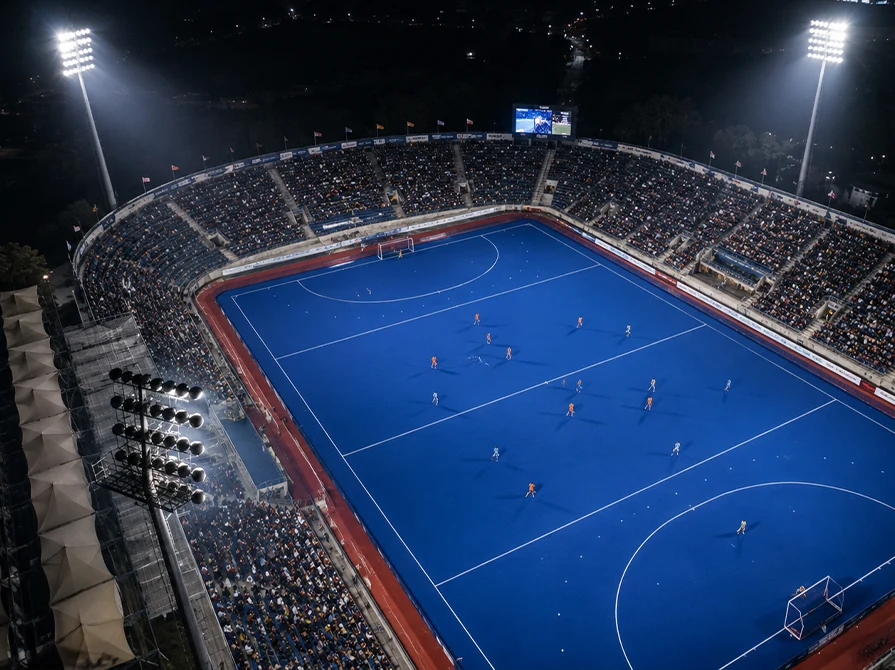
Uniform illumination therefore matters beyond player comfort. It helps reduce sudden changes in the image as an athlete or ball moves from one zone to another. Controlled beam distribution and reduced shadows help keep movement readable. Appropriate illumination from the directions in which cameras observe the action helps reveal players, uniforms, field markings and the ball with greater consistency.
Flicker performance is equally important. Broadcast production increasingly relies on high-definition footage and slow-motion replay to reveal events that happen in fractions of a second. Lighting that performs well at normal speed may behave differently when footage is slowed down. Flicker-free lighting helps cameras preserve clarity across frames, allowing fast movement to be replayed without distracting bands or fluctuations.
Colour quality also contributes to the information captured. Accurate and consistent colour rendering helps distinguish uniforms, playing surfaces and other visual details. Glare control, meanwhile, is not only about reducing discomfort for players. It also helps prevent excessive brightness from interfering with cameras positioned around the venue.
The job does not end at commissioning. As luminaires age, aiming changes or parts of the venue are modified, the visual environment can shift. Monitoring, maintenance and periodic performance checks help ensure that the system continues to deliver the conditions for which it was designed.
These requirements cannot be considered after the lighting layout has already been finalised. Camera locations, mast positions, beam angles, replay requirements and the areas covered by tracking systems should inform the design process early. Lighting designers, venue consultants, broadcasters and technology partners need to treat the field as one connected visual environment.
This is why the future of sports lighting will not be defined by output alone. It will be shaped by how reliably light supports people, cameras and the technologies that increasingly influence decisions on the field.
Wipro Lighting’s sports-lighting approach brings together high-performance output, multiple beam-angle choices, colour-rendering configurations and flicker-free options across the Olympus range. The larger opportunity, however, is to think beyond the luminaire: to design lighting as an essential layer of modern sporting infrastructure.
Because the next audience in the stadium may not cheer, blink or look away. But it still needs to see every movement clearly.