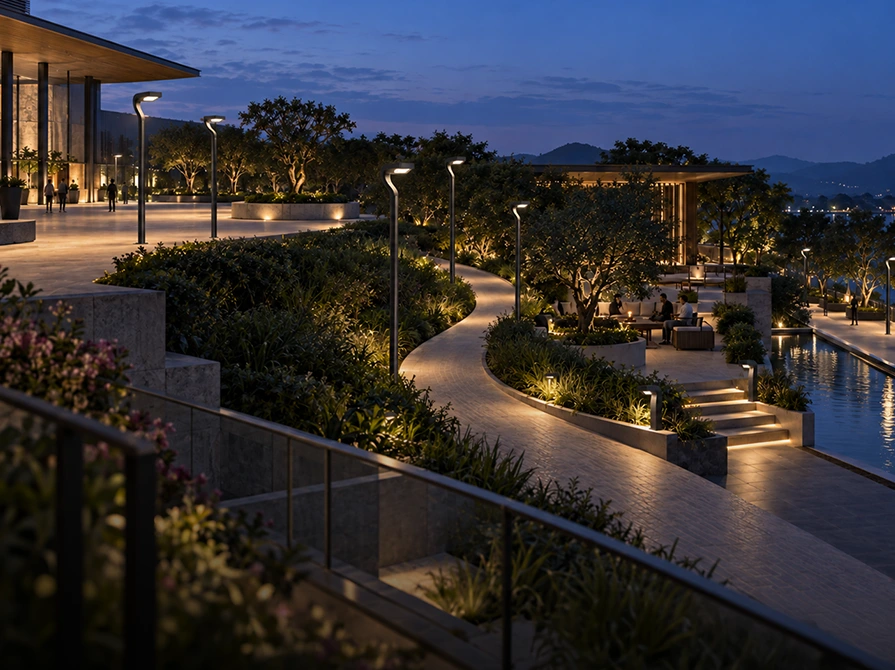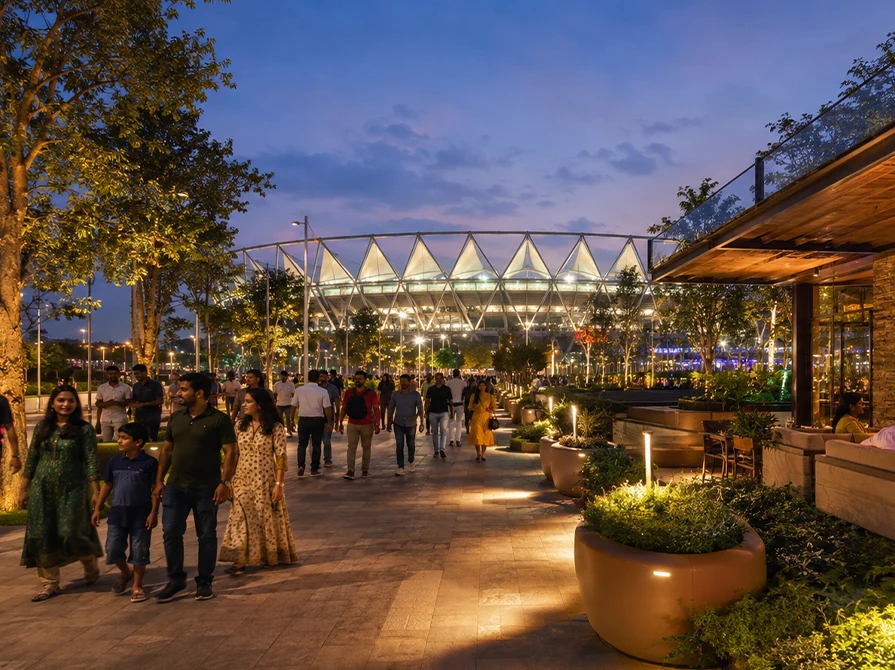


Landscape lighting is often discussed at the scale of the site.
How does the promenade read after dark? How does the garden connect with the building? How does the lighting establish hierarchy across a campus or public realm?
All are important questions.
But much of the actual experience of those environments happens within a much smaller area: the few metres immediately surrounding the person moving through them.
It is where paving changes. Where a path curves. Where planting meets circulation. Where a step begins. Where somebody decides whether the route continues left or right.
At this scale, lighting has a different job.
Higher-mounted luminaires are useful when illumination needs to address a broader area.
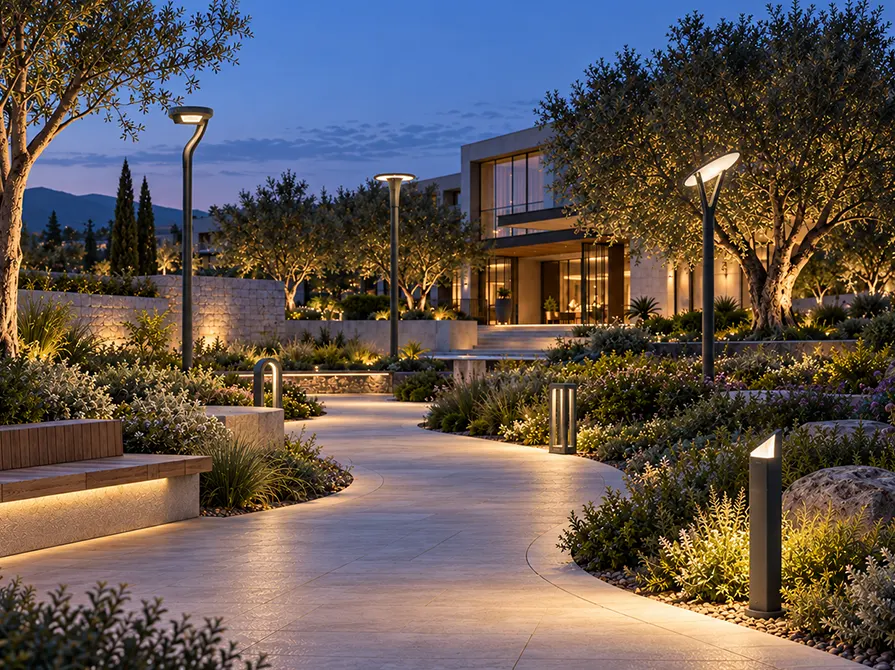
Bollards work closer to the walking plane.
That proximity allows low-level lighting to engage directly with pathways, landscape edges and the surfaces people encounter as they move.
The distinction matters because orientation is rarely a question of brightness alone.
People interpret contrast, boundaries, material changes, vertical objects and continuity. A carefully positioned bollard can contribute to these cues without asking the entire surrounding landscape to carry the same illumination level.
Even within low-level lighting, the requirement can vary considerably.
Some environments need restrained guidance.
Others may ask the luminaire to contribute more strongly to the visual identity of the landscape.
Wipro Lighting's Utopia range reflects this breadth through bollards with very different expressions — from restrained architectural forms such as Strix, Quad and Elevate to the patterned character of Nyx.
Products such as Whistling Oyster and Whistling J Bollard extend the role even further by integrating speaker functionality into the outdoor element.
So the question is no longer simply:
“Which bollard should illuminate the pathway?”
It can become:
“What should this part of the landscape do for the person experiencing it?”
Because low-level lighting sits closer to occupants, its relationship with distribution, visual comfort and restraint also deserves careful consideration.
The aim is not necessarily to make everything visible at equal intensity.
It is to reveal enough.
Enough of the path to understand the way forward.
Enough of an edge to read a boundary.
Enough of the surrounding environment to establish context.
And enough darkness for the landscape to retain depth.
Landscape lighting may ultimately be resolved at the scale of a masterplan.
But its success is often judged much closer.
One step.
One edge.
One person.
One metre at a time.
Utopia by Wipro Lighting.
Innovation for Human Spaces.