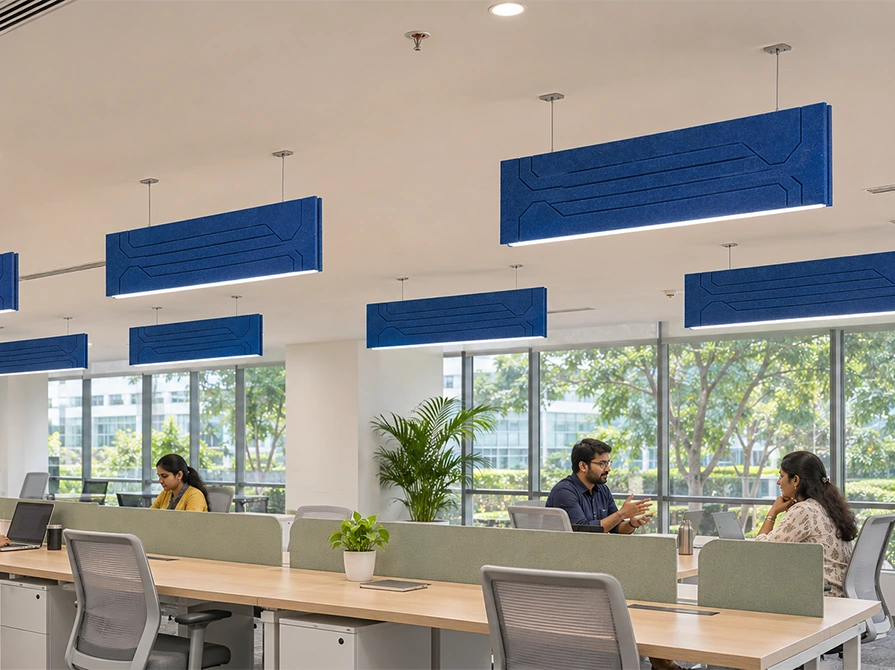
Acoustic light fixtures for Indian offices are available in several formats, including acoustic pendant lights, integrated acoustic panels, and suspended baffle systems. When specifying them, evaluate sound absorption (NRC), colour rendering (CRI), lumen output, correlated colour temperature (CCT), glare, and dimming compatibility. These parameters help architects, interior designers, project management consultants (PMCs) and procurement teams select fixtures that balance visual comfort with acoustic performance.
For open-plan offices, co-working spaces, conference rooms and business process outsourcing (BPO) facilities, the buying decision goes beyond appearance. The right combination of lighting and sound-absorbing materials can improve the working environment while supporting project requirements for energy efficiency, acoustic comfort, and green building certification.
Acoustic lighting integrates illumination with sound-absorbing materials, allowing one ceiling installation to contribute to both lighting and acoustic design. Standalone acoustic panels, by comparison, provide sound absorption without integrated lighting.
| Fixture type | Description | Best application | Indicative acoustic performance | Typical format |
|---|---|---|---|---|
| Acoustic pendant | Suspended luminaire with acoustic material integrated into its design | Open offices, co-working spaces, meeting areas | Depends on tested product; Wipro Hexa specifies 0.51 m² Sabin | Hexagonal |
| Acoustic panel or troffer | Ceiling panel or luminaire combined with acoustic backing | Grid-ceiling offices, conference rooms | Depends on panel construction and exposed absorption area | Square or rectangular |
| Acoustic baffle | Suspended vertical or horizontal acoustic element, potentially integrated with lighting | Large offices, atriums, collaborative zones | Depends on material, dimensions and installation | Linear blade |
| Acoustic downlight | Recessed light with an acoustic surround | Reception areas, corridors, selected meeting spaces | Depends on the absorbing surround and available surface area | Circular |
NRC, or Noise Reduction Coefficient, is a single-number rating of sound absorption. Sabin measures equivalent sound absorption in square metres. These metrics describe related but different properties, so compare products using the actual test data and units supplied by the manufacturer.
The following parameters help assess whether an acoustic lighting fixture suits a commercial office project.
| Specification | What to look for | Why it matters |
|---|---|---|
| Acoustic performance | Published NRC or equivalent sound absorption data, with test conditions | Helps estimate the fixture's contribution to room acoustics |
| CRI | CRI 80+ for general office use; consider CRI 90+ for colour-critical tasks | Supports accurate colour perception |
| CCT | 3000K for warmer settings; 4000K for neutral office lighting; 5000K or 5700K where suitable for the task and design | Shapes the visual character of the space |
| Illuminance | Common office design targets are around 300 to 500 lux at the working plane, subject to task and applicable standards | Supports comfortable and effective visual work |
| Glare | Review UGR or applicable glare data and the luminaire's optical design | Helps reduce visual discomfort |
| Efficacy | Compare delivered lumens per watt from verified product data | Helps assess energy performance |
| IP rating | IP20 may suit dry indoor areas; higher protection may be needed in exposed or splash-prone locations | Matches the fixture to environmental conditions |
| Driver and dimming | Confirm compatibility with DALI, 0–10V or the specified control system | Supports dimming and lighting control integration |
| Warranty and service | Confirm warranty terms for the LED system, driver and acoustic material | Helps establish lifecycle support |
The lighting layout should be designed to deliver maintained illuminance across desks and circulation areas. India's IS 3646 series provides a reference for interior illumination, and the applicable edition and project requirements should be confirmed during design. The 300 to 500 lux range is a useful planning reference for many office tasks, rather than a universal requirement for every office zone.
For acoustic performance, treat any suggested NRC target as a project selection criterion rather than a guarantee of room-level results. A fixture with high absorption can contribute to acoustic comfort, but the outcome also depends on room volume, occupancy, furniture, wall finishes, and ceiling construction.
Wipro Hexa is a hexagonal pendant luminaire designed to combine decorative geometry with acoustic performance. It is suited to collaborative workspaces and office interiors where the lighting installation also contributes to the overall ceiling design.
Wipro's published product information lists the following specifications:
| Parameter | Published specification |
|---|---|
| Form | Hexagonal pendant |
| Available sizes | 600 mm and 800 mm |
| Wattage | 30W for 600 mm; 40W for 800 mm |
| CCT options | 3000K, 4000K and 5700K |
| Sound absorption | 0.51 m² Sabin |
| Mounting | Pendant suspension |
| Dimming | Analog and DALI options listed in the product information |
| Optical specification | UGR below 19 diffuser listed on the product page |
The product page lists its own electrical and optical specifications, but project teams should request the current datasheet for the exact catalogue reference, including efficacy, CRI, dimensions, driver details, and configuration. Confirm the acoustic test basis and the applicable mounting conditions before using its absorption figure in a room-acoustic calculation.
Lighting quantity and acoustic fixture quantity should be calculated separately, then coordinated into a single layout.
A common preliminary lumen-method formula is:
Number of fixtures = (Target illuminance × Floor area) ÷ (Lumens per fixture × Utilisation factor × Maintenance factor)
Consider a 100 m² open office with a target of 400 lux. Assume a utilisation factor of 0.65 and a maintenance factor of 0.80.
Required initial lumens:
400 × 100 ÷ (0.65 × 0.80) = approximately 76,923 lumens.
If the selected luminaire delivers 4,000 lumens, the preliminary quantity is:
76,923 ÷ 4,000 = approximately 20 fixtures.
This is an illustrative calculation, not a final layout. Actual lumens per fixture must come from the selected product datasheet. A lighting designer should verify spacing, uniformity, glare, ceiling height, daylight and maintained illuminance before approving the design.
For acoustic design, use the manufacturer's tested sound absorption data and the room's geometry, finishes, and intended use. Wipro Hexa lists 0.51 m² Sabin of sound absorption per unit. Ten units would therefore contribute a nominal 5.1 m² Sabin based on that published figure.
That contribution alone does not establish the room's RT60. Reverberation time depends on the room volume and the total sound absorption across relevant surfaces and frequencies. An acoustic consultant should model or measure the room to establish whether additional ceiling tiles, wall panels, screens or other treatments are needed.
Acoustic lighting can contribute to a broader workplace comfort strategy, but certification is assessed at the project level.
For certification-led projects, coordinate the lighting designer, acoustic consultant and certification professional early. Confirm the required evidence, calculations and measurements before finalising the luminaire schedule.
Before installation, coordinate the following with the architect, electrical consultant, acoustic consultant and contractor:
The best option depends on the ceiling, required lighting levels, acoustic objectives, and interior design. Acoustic pendants can work well in open offices, while acoustic panels and baffles may suit other ceiling layouts. Compare verified sound absorption data and photometric performance before selecting a fixture.
Use the project's acoustic design criteria to set the target. A higher NRC can be a useful screening factor, but room reverberation also depends on the quantity and placement of absorbing surfaces, room volume, and furnishings.
There is no fixed quantity based on floor area alone. Calculate the lighting requirement from target lux and actual fixture lumens, then have an acoustic consultant determine how many units are needed to meet the room's acoustic objectives.
A fixture's acoustic performance does not automatically establish WELL certification. WELL requirements apply to the project and may involve room-level reverberation, lighting quality, and verification. Review the applicable WELL version and required documentation.
Acoustic pendants combine a suspended luminaire with sound-absorbing material, often as a single designed element. Acoustic baffles are suspended acoustic elements, frequently arranged vertically or in rows, and may incorporate lighting depending on the product system.
Yes. Wipro Lighting lists an acoustic lighting range that includes Hexa, with published product specifications for size, wattage, CCT, suspension, and sound absorption. Consult the current product information and contact Wipro for project-specific configuration and specification support.
The right acoustic lighting specification balances illumination, sound absorption, visual comfort, installation constraints, and lifecycle support. Start with the needs of the space, calculate the lighting layout, and use verified acoustic data to assess the contribution of each fixture to the room's overall performance.
Wipro Lighting's acoustic lighting range includes Hexa, designed for collaborative and modern office interiors. For project-specific recommendations, speak to a Wipro lighting specifier and review the product data before finalising your specification.