

India is building at extraordinary speed.
By 2036, India’s towns and cities are expected to be home to nearly 600 million people, or close to 40% of the country’s population. Urban areas are also expected to contribute a major share of India’s economic growth. (ref. - worldbank.org)
This means the way we design urban infrastructure today will shape how millions of people live, move, work and gather tomorrow.
But one question still deserves more attention.
Lighting is often treated as the final layer of an urban project. Once the road is built, the landscape is complete or the façade is ready, lighting is added to make the space visible.
That approach is no longer enough.
Because urban lighting is not only about visibility. It is about precision.
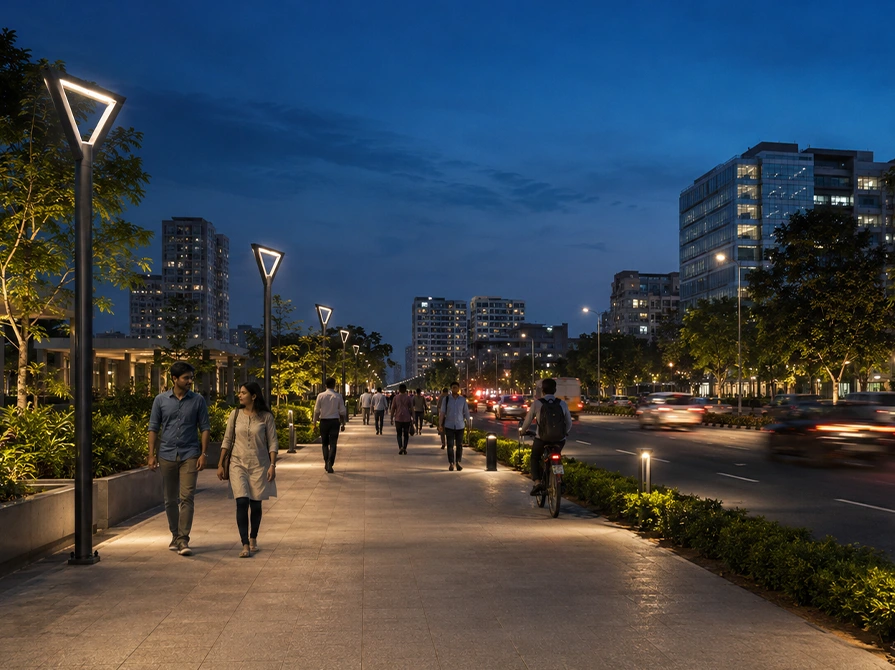
A pathway needs light that helps people move with confidence.
A garden needs light that creates comfort without overpowering nature.
A plaza needs light that supports pause, interaction and safety.
A façade needs light that reveals identity without creating glare.
A campus or avenue needs light that feels secure, but not harsh.
The challenge is to control where the light goes, how evenly it spreads, how much glare it creates, how efficiently it performs and how responsibly it interacts with the night.
This is where optics become central to the future of outdoor lighting.
Wipro Lighting’s OptiVance™ is an in-house designed advanced optics system created to improve the way outdoor luminaires perform. It enables symmetric and asymmetric light distribution, helping designers choose the right spread of light for the right application.
Symmetric distribution helps illuminate evenly around the luminaire. This is useful for spaces where balanced, all-side illumination is required.
Asymmetric distribution helps direct light more precisely in a chosen direction. This becomes important for pathways, roadsides, edges, gardens and public spaces where light needs to fall on the activity zone, and not spill unnecessarily into homes, trees, water bodies or the sky.
This difference matters.
When light is poorly distributed, cities compensate by using more brightness. More brightness then leads to more glare, more waste, more skyglow and more discomfort.
But when optics are designed well, the same space can feel safer and more comfortable with better-controlled light.
OptiVance™ helps reduce glare, improve uniformity and deliver controlled illumination with high efficacy. It supports the creation of outdoor environments where people can see clearly without feeling exposed to harshness.
For architects, MEP consultants, planners, developers and infrastructure teams, this shifts the lighting conversation.
How bright should this space be?
The better questions are:
Where should the light go?
What should remain unlit?
Does the space need symmetric or asymmetric distribution?
Can glare be reduced?
Can uniformity be improved?
Can energy be saved without compromising comfort?
Can the night be respected while the space remains safe?
This is especially important for India’s evolving public realm.
As cities expand, outdoor spaces will need more than standard pole lighting. They will need layers. Post tops for pathways, gardens and avenues. Bollards for movement edges and pause points. Column lights for urban presence and identity. Smart controls for adaptive performance. Solar solutions where independence and lower load are important.
Wipro Lighting’s Utopia range brings these layers together through post tops, bollards and column lights designed for landscape and urban environments. With OptiVance™ at the heart of performance, these luminaires are not only designed to look elegant. They are designed to distribute light with greater intent.
Not just brightness.
Distribution.
Not just visibility.
Comfort.
Not just illumination.
Responsibility.
India’s cities will certainly be lit.
The real question is whether they will be lit with precision.
Because a better-lit India does not have to be brighter everywhere.
It can be better designed everywhere.