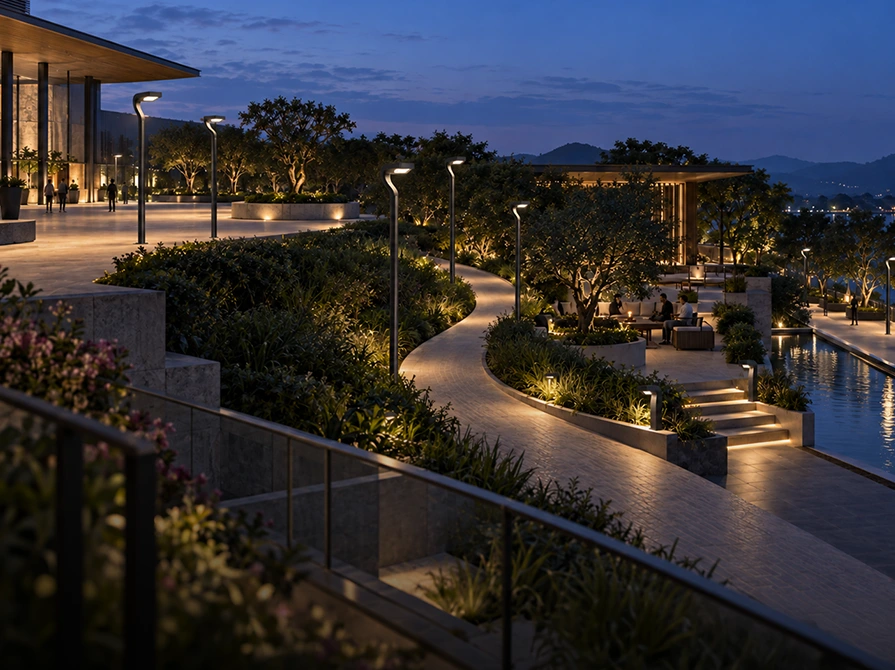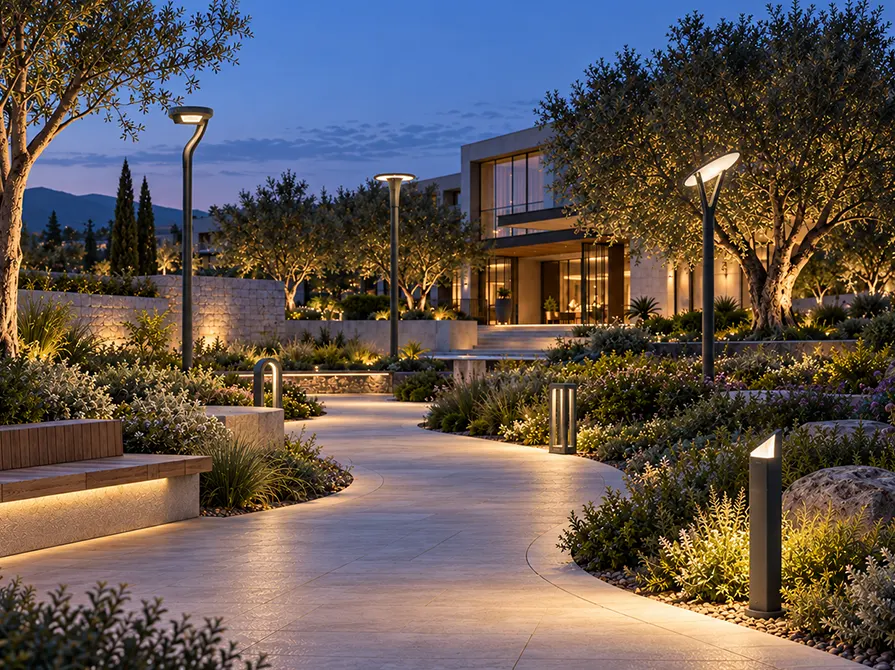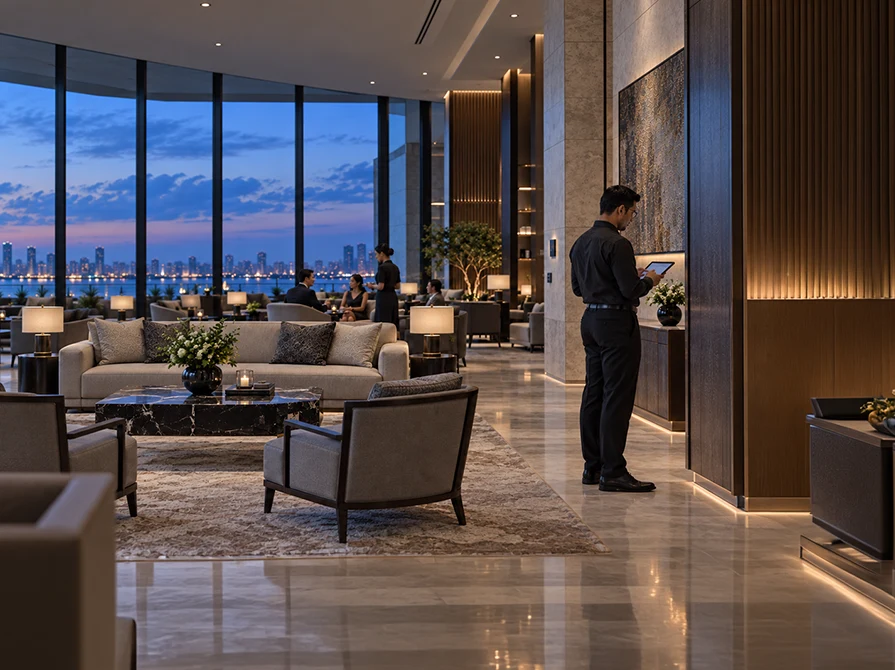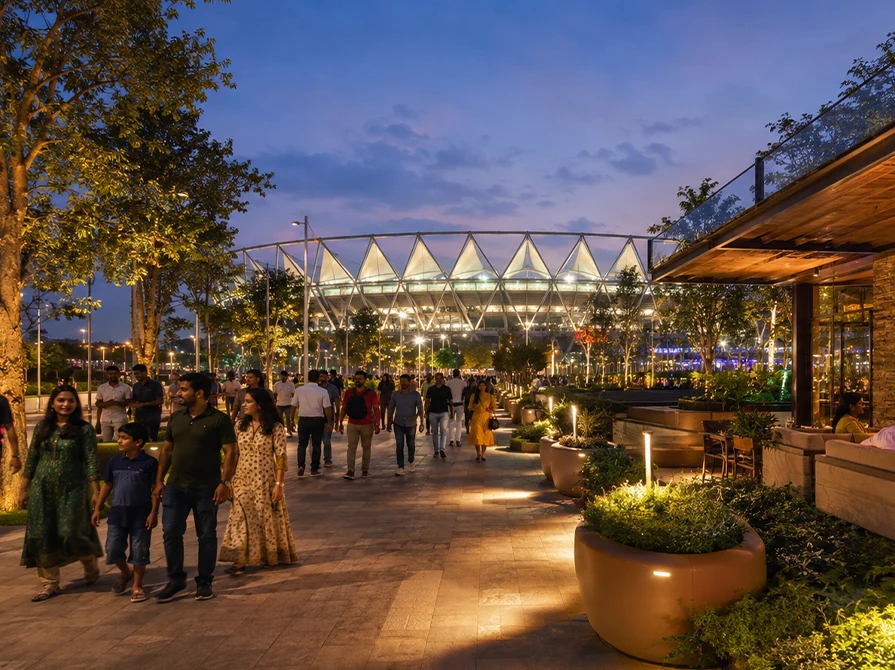


A building's exterior creates its first impression, and that impression continues after sunset. For offices, hotels, IT parks, retail developments, hospitals, educational campuses, and housing societies, facade lighting can shape how a property looks, feels, and functions at night.
A well-planned facade lighting system can highlight architectural features, strengthen brand identity, improve wayfinding, support security, and create a distinctive presence after dark. The right solution depends on the building's architecture, facade material, surrounding environment, operating hours, and desired visual effect.
This guide covers the essentials of facade lighting in India, including fixture types, lighting techniques, colour temperatures, IP ratings, energy efficiency, smart controls, and specifications to consider during procurement.
Facade lighting refers to the deliberate illumination of a building's exterior surfaces, including walls, columns, entrances, architectural features, and surrounding landscape elements. It uses carefully selected fixtures and lighting techniques to enhance visual appeal, reinforce identity, improve security, support wayfinding, and create a defined nighttime presence.
A building can have a strong architectural identity during the day and a completely different visual character at night. Facade lighting allows corporate offices, hotels, retail destinations, and landmark properties to maintain their identity after sunset.
Well-lit entrances, pathways, boundaries, and building perimeters improve visibility after dark. Properly positioned lighting can support security personnel and CCTV systems while creating a more comfortable environment for visitors and occupants.
Lighting helps visitors identify entrances, drop-off zones, pedestrian paths, parking areas, and other important zones. This is particularly useful across large campuses and mixed-use developments.
Illuminated facades can contribute to the perceived quality and visual appeal of a property. For housing societies, commercial developments, and hospitality properties, exterior lighting can become part of the overall experience of the development.
Entrances, lobbies, pathways, gardens, and common areas form the first few touchpoints for visitors. Coordinated lighting can create a welcoming and visually consistent environment.
Wall washers provide broad, even illumination across large exterior surfaces. They can be installed at ground level or on horizontal surfaces and are commonly used for flat facades, columns, boundary walls, and large architectural surfaces.
Spotlights use narrower beams to highlight specific architectural elements. They are useful for entrance canopies, signage, sculptures, trees, heritage details, and building name boards.
These wall-mounted fixtures distribute light upward and downward, creating a layered pattern across walls and boundaries. They are commonly used around hotel entrances, office lobbies, residential gates, and building perimeters.
Linear LED profiles create continuous lines of light that can trace building edges, floor plates, architectural contours, and facade features. They are particularly suited to modern commercial towers, IT parks, hotels, and contemporary architectural designs where clean lines form part of the building's identity.
Bollards provide low-level illumination for pathways, entrances, gardens, and perimeter areas. They complement facade lighting by bringing light closer to the pedestrian level.
Flood lights provide high-output illumination for large surfaces and structures. They are useful for commercial complexes, campuses, heritage buildings, stadiums, and other large-scale facades. Key specifications include wattage, lumen output, beam spread, and IP rating.
RGBW fixtures enable dynamic colour control across a facade. They can be used for brand colours, festive lighting, special events, celebrations, and hospitality applications. DMX or wireless control systems can be used to create programmable colour scenes and sequences.
The fixture is one part of the design. How and where the light is directed determines the visual effect.
Fixtures positioned at ground level direct light upwards to emphasise the height and form of a building. Uplighting works particularly well for columns, vertical architectural elements, trees, and textured surfaces.
Fixtures installed at height direct light downwards. This creates a softer and more controlled effect and works well for entrances, pathways, balconies, and architectural projections.
Grazing places fixtures close to and parallel with a textured surface. The light reveals variations in stone, brick, concrete, and other materials by emphasising their texture.
Wall washing creates relatively even illumination across a surface. It works well for large flat facades where the objective is consistent brightness across the building face.
Silhouetting places light behind an architectural feature or object, creating a defined outline. It can create strong visual effects around sculptures, landscape elements, and distinctive building forms.
Directional lighting can create intentional shadows from columns, screens, projections, and other architectural features. This introduces depth and visual interest to the facade.
Colour temperature has a significant influence on how a building is perceived at night.
Warm white creates a welcoming and premium character. It is commonly suited to hotels, heritage buildings, hospitality properties, and residential developments.
Neutral white creates a clean and professional appearance. It works well for corporate offices, IT parks, educational institutions, and healthcare facilities.
Cool white provides a crisp appearance and strong visibility. It can be considered for industrial facilities, logistics parks, and security-focused applications.
RGBW systems allow buildings to use programmable colours for brand identity, festivals, events, and special occasions.
Colour temperature should remain visually consistent across zones that form part of the same facade. Mixing warm and cool white sources without a deliberate design concept can create an uneven visual appearance.
Outdoor facade fixtures operate through India's heat, dust, humidity, and monsoon conditions, making ingress protection an important specification.
LED technology has become the preferred choice for modern facade lighting because of its energy efficiency, long operating life, controllability, and instant-on performance.
Compared with conventional metal halide and halogen systems, LED facade lighting can deliver substantial energy savings while providing greater flexibility in fixture design and controls.
Smart controls can further improve operating efficiency.
Astronomical timers automatically schedule lighting based on local sunrise and sunset times, helping align operating hours with actual daylight conditions.
Facade lighting can be dimmed during late-night or low-footfall periods while maintaining the desired visual presence.
Different scenes can be programmed for regular operation, festive periods, corporate events, national occasions, and special celebrations.
Facade lighting controls can be integrated with Building Management Systems to coordinate lighting with broader building operations and energy management.
RGBW facades can use DMX or wireless protocols to create programmable colour scenes and dynamic lighting sequences.
Connected lighting systems can provide energy consumption data, operating status, and fault information to support facility management and sustainability reporting.
Corporate buildings typically benefit from a professional and restrained lighting approach. Neutral white lighting, subtle architectural accents, entrance illumination, and signage highlights can reinforce corporate identity. Energy efficiency and smart scheduling are important considerations for large office campuses operating across extended hours.
Hotels benefit from warm, layered lighting that creates a welcoming arrival experience. Facade lighting can extend across the entrance, drop-off zone, porte-cochère, pool perimeter, gardens, and building silhouette.
Lighting scenes can also be programmed for regular evenings, festivals, events, and special occasions.
Residential developments generally combine security and aesthetics. Entrance gates, perimeter walls, clubhouses, pathways, gardens, and common areas can use a coordinated lighting scheme.
Bollards and wall-mounted fixtures can provide pedestrian-level illumination alongside architectural facade lighting.
Retail properties require high-impact lighting that supports visibility and commercial identity. Facade lighting can highlight shopfronts, signage, atriums, entrances, and car park access points.
Dynamic lighting can also be used for seasonal campaigns and special events.
Healthcare properties benefit from clear, calming, and functional exterior lighting. Entrance zones, emergency access, parking areas, pathways, and building identification should receive particular attention.
Wayfinding and accessibility should remain central to the lighting plan.
Educational campuses can combine security, wayfinding, and institutional identity. Main gates, administrative buildings, academic blocks, pathways, and landmark structures can form the primary lighting zones.
Industrial and logistics facilities generally prioritise security, visibility, and operational requirements. Perimeters, gates, loading areas, office blocks, parking zones, and access roads should be considered as part of the overall outdoor lighting plan.
Different colour temperatures across connected facade zones can create visual inconsistency. Define a colour temperature strategy during the design stage.
Using too many fixtures or unnecessarily high wattage can increase glare, energy consumption, and spill light. Photometric planning helps establish appropriate fixture quantities and output.
Outdoor fixtures need protection appropriate to their location and exposure. Ground-level, coastal, and water-adjacent applications may require higher protection levels.
Astronomical timers, dimming, and scheduling can align facade lighting with actual operating requirements.
Side and rear facades, pathways, parking areas, and boundaries can form important parts of the overall lighting and security strategy.
Light should be directed carefully to maintain the intended visual effect while managing illumination beyond the property boundary.
Fixture performance over time matters for a facade expected to maintain a consistent appearance for years. Evaluate rated life, lumen maintenance, warranty, and service support alongside initial fixture cost.
Before finalising a facade lighting system, define:
What is facade lighting?
Facade lighting is the deliberate illumination of a building's exterior surfaces, including walls, columns, architectural features, entrances, and surrounding landscape elements. It uses artificial light to enhance visual appeal, reinforce identity, improve security, support wayfinding, and create a defined nighttime presence.
What type of lights are used for building facades?
Common fixture types include wall washers for even surface illumination, spotlights and focus lights for architectural accents, up-down lights for layered effects, linear LED profiles for architectural outlines, flood lights for large surfaces, bollards for pathways, and RGBW fixtures for dynamic colour effects.
What colour temperature is best for facade lighting?
The right colour temperature depends on the building type and desired visual effect. Warm white around 3000K suits hotels, heritage buildings, and residential developments. Neutral white around 4000K works well for corporate offices and institutions. Cool white between 5000K and 6500K can suit industrial and security-focused applications.
What IP rating is required for outdoor facade lighting in India?
IP65 is a suitable baseline for outdoor facade lighting. IP66 can be considered for coastal locations and areas with heavy monsoon exposure. In-ground fixtures and applications with greater water exposure may require IP67 or IP68.
How much energy can LED facade lighting save?
LED facade lighting can deliver substantial energy savings compared with conventional metal halide and halogen systems. Smart controls such as astronomical scheduling, dimming, and scene-based operation can further reduce energy consumption by matching lighting output and operating hours to actual requirements.
Can facade lighting be controlled remotely or automated?
Yes. Modern facade lighting systems can integrate astronomical scheduling, dimming, scene presets, energy monitoring, and remote management. RGBW systems can use DMX or wireless protocols for programmable colour scenes.
How long does outdoor LED facade lighting last?
High-quality LED facade fixtures can have rated lifespans of 50,000 hours or more, depending on the product and operating conditions. At eight hours of operation per night, 50,000 hours represents approximately 17 years of operating time. Actual service life depends on factors such as thermal management, environmental conditions, operating hours, and maintenance.
Facade lighting brings together architecture, technology, energy efficiency, security, and visual experience. The right solution begins with understanding the building, its surroundings, materials, operating requirements, and desired nighttime identity.
From corporate offices and IT parks to hotels, residential communities, hospitals, campuses, and industrial facilities, each building calls for a different lighting approach. Wipro Lighting's outdoor lighting portfolio provides solutions for architectural, facade, pathway, floodlighting, and smart outdoor applications.
Get in touch with Wipro's outdoor lighting team for a facade lighting specification tailored to your building.