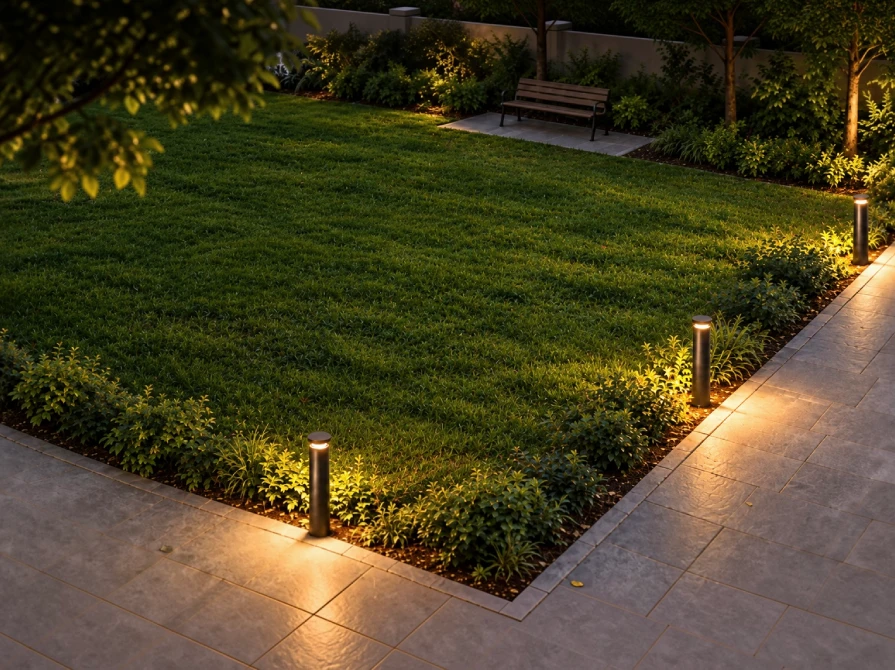
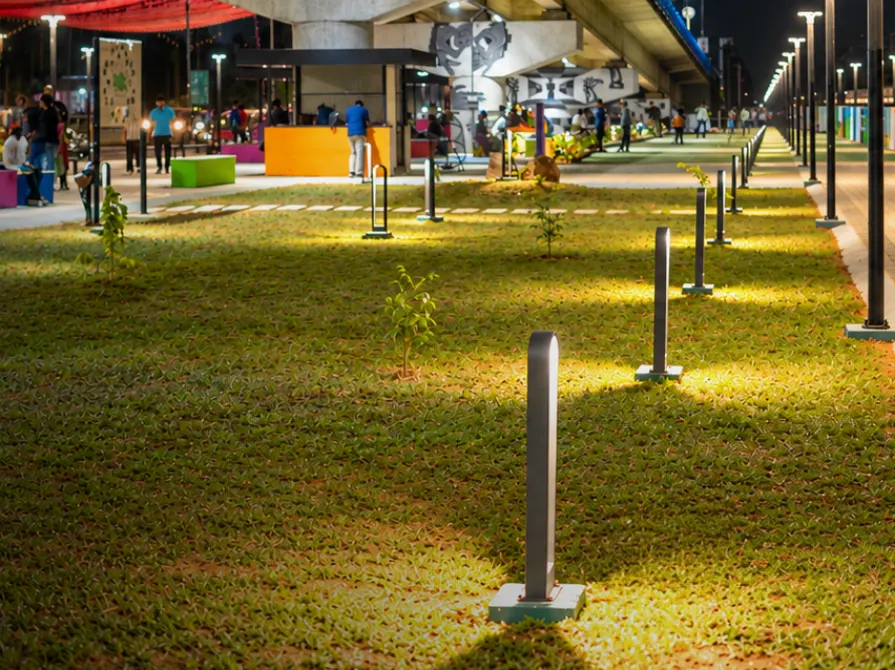
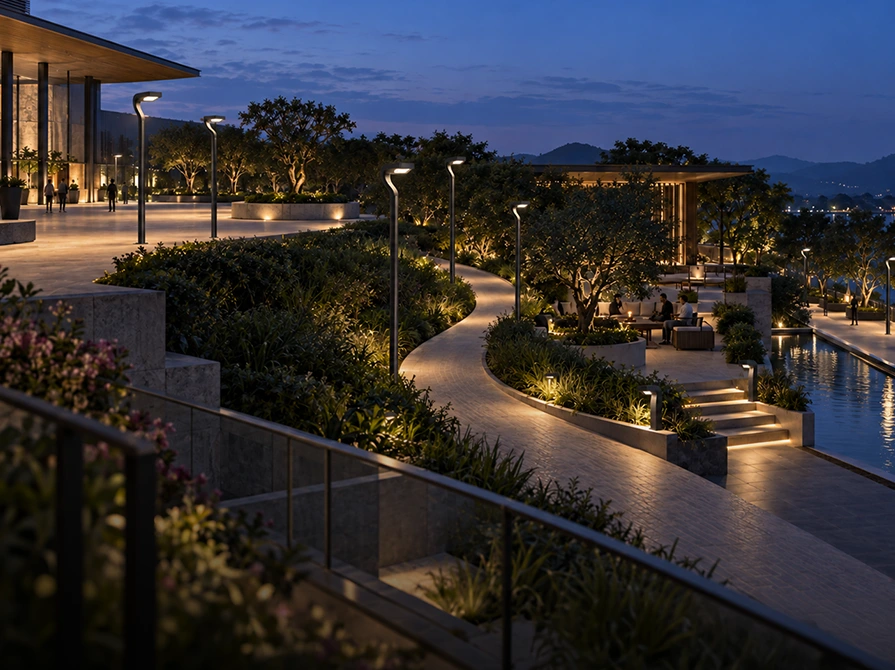
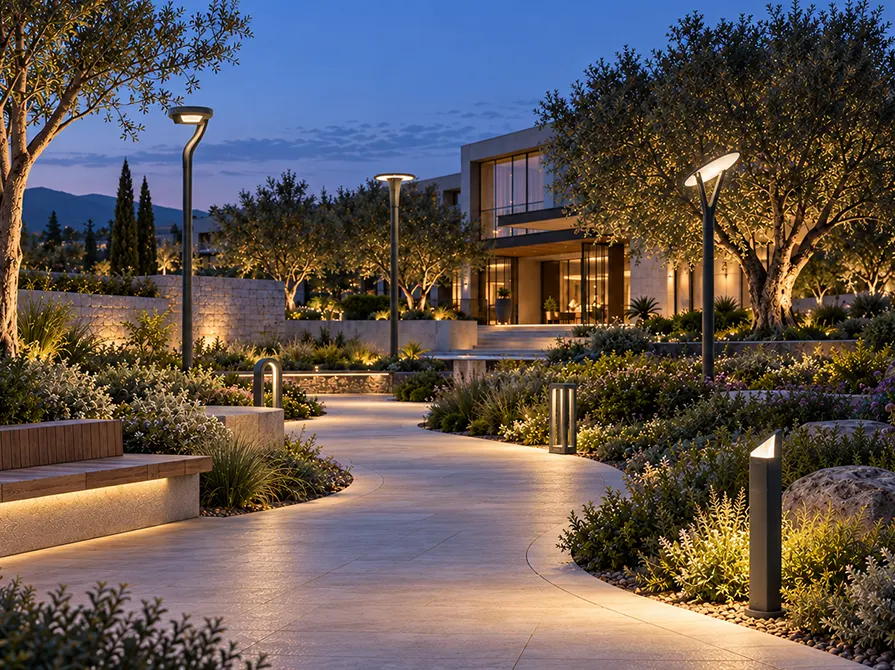
Landscape lighting lux levels in India typically range from 5–10 lux for garden pathways to 75–150 lux for entrance signage and monuments. The right level depends on the zone, visual task, surface reflectance, uniformity and safety requirements. These figures are indicative design recommendations for commercial landscapes, hotels, resorts and campuses, rather than mandatory levels prescribed by IS 3646.
Over-lighting can waste energy, create glare and diminish a landscape's ambience. Under-lighting can make pathways, steps and entrances harder to navigate after dark. A well-designed landscape lighting system balances visibility, aesthetics and energy efficiency while accounting for India's dust, monsoon rainfall and outdoor temperatures.
Lux measures illuminance, or the amount of light falling on a surface. One lux equals one lumen per square metre.
Lumens describe the total visible light output of a source, while watts measure electrical power consumption. A higher-wattage fixture does not automatically deliver better illumination because optical efficiency, beam angle, mounting height and light distribution also matter.
For outdoor landscape lighting, lux is measured at the illuminated surface, not at the fixture. For example, if 500 lumens of light reach a tree canopy covering 2 m², the average illuminance would be approximately 250 lux. This is an idealised calculation: in practice, some light misses the canopy, and illumination varies across the surface.
Landscape lighting design should consider both average illuminance and uniformity. A pathway with evenly distributed light can be easier to navigate than one with bright spots separated by deep shadows.
IS 3646 is the Indian Standard for interior illumination. The current listing includes IS 3646: Part 1: 2025, covering general requirements and recommendations for working interiors. It is not a dedicated standard prescribing lux levels for every outdoor landscape zone.
For outdoor commercial landscapes, designers can use established illumination principles alongside project requirements, relevant outdoor-lighting guidance and applicable safety standards. IS 3646 may provide useful context for lighting quality, but its interior recommendations should not be represented as mandatory landscape lux levels.
Public roads and traffic areas also require separate consideration under the applicable road-lighting standards. Private garden paths, hotel landscapes and campus walkways should be designed according to their intended use and site conditions.
The following reference table provides starting points for landscape lighting design in private commercial properties, hotels, resorts and campuses. Final levels should be confirmed through photometric calculations and on-site requirements.
| Landscape zone | Indicative illuminance | Primary purpose | Design considerations |
|---|---|---|---|
| Public or commercial pathways | 5–10 lux | Pedestrian movement | Uniform light, low glare |
| Private garden paths | 10–20 lux | Navigation and ambience | Bollards or recessed lights |
| Entrance driveways and motor courts | 20–50 lux | Vehicle and pedestrian movement | Uniform distribution, clear transitions |
| Building facades | 30–75 lux | Architectural highlighting | Adjust for surface reflectance and texture |
| Entry monuments and signage | 75–150 lux | Visibility and legibility | Control spill light and glare |
| Outdoor seating and dining areas | 50–100 lux | Comfortable social interaction | Dimming and layered lighting |
These are indicative design ranges, not universal statutory requirements. Actual values depend on the task, operating hours, surrounding brightness, fixture optics and the distinction between horizontal and vertical illuminance.
For example, a sign may need adequate vertical illuminance across its face, while a pathway is assessed primarily at ground level. A facade's appearance also depends on its colour, texture and reflectance.
This reference table is intended for private commercial landscapes, hotels, resorts and campuses, not public road lighting. Roadway projects require the relevant road-lighting standards and design criteria.
The basic relationship is:
Lux = Lumens reaching the surface ÷ Illuminated area in m²
This simplified formula is useful for initial estimates. A real lighting design must account for the fraction of light reaching the target, beam distribution, mounting geometry, reflected light, and maintenance losses.
Suppose a pathway section covers 12 m² and the design target is 10 lux.
Required light reaching the pathway:
10 lux × 12 m² = 120 lumens.
This means the pathway needs approximately 120 lumens of useful light reaching that area under the simplified calculation. The installed fixtures will generally need a higher total lumen output because some light falls outside the target area.
The final bollard quantity, spacing, and output should be determined using the manufacturer's photometric data and a lighting calculation.
Suppose a tree canopy has an illuminated target area of 2 m² and the intended average illuminance is 100 lux.
Required light reaching the canopy:
100 lux × 2 m² = 200 lumens.
If the spotlight delivers only a portion of its output onto the canopy, its rated lumen output must exceed 200 lumens. Beam angle, distance, foliage density, and the desired visual effect will influence the fixture selection.
For larger projects, photometric design software can model illuminance distribution, identify dark patches, and help avoid excessive lighting.
Different landscape zones require different fixtures depending on the area being illuminated, the desired lighting effect, and the environmental conditions. The right fixture should deliver the required lux levels while controlling glare, light spill and energy consumption.
| Fixture type | Best suited for | Key specifications |
|---|---|---|
| Bollard lights | Garden paths, walkways and campus landscapes | Appropriate height and spacing, controlled light distribution, IP65 or suitable higher protection |
| In-ground uplights | Trees, columns and architectural features | Suitable beam angle, drainage provisions, impact resistance and ingress protection |
| Underwater lights | Fountains, ponds and reflecting pools | Purpose-designed underwater construction, appropriate immersion rating and electrical safety provisions |
| Wall washers | Building facades and boundary walls | Uniform vertical illumination, suitable beam distribution and glare control |
| Spike spotlights | Trees, shrubs, sculptures and ornamental plants | Adjustable aiming, suitable beam angle and weather-resistant construction |
For many private garden paths, 10–20 lux is a useful initial design range. Less busy ambient paths may need less, while steps, changes in level and higher-traffic routes require separate assessment.
Divide the lumens reaching the target surface by the illuminated area in square metres. For an accurate design, account for beam distribution, mounting height, light losses, and uniformity using photometric data.
IS 3646 primarily addresses interior illumination and does not prescribe universal lux levels for outdoor landscape zones. Its lighting principles can inform design, but outdoor recommendations should be established using applicable project criteria and relevant outdoor-lighting guidance.
The theoretical relationship is one lumen reaching a square metre for every lux required. For example, a target of 10 lux across 10 m² requires 100 lumens to reach the surface under idealised assumptions. Installed output must account for optical and maintenance losses.
Lumens measure the total visible light output of a source, while lux measures how much light reaches a surface. A fixture's lumen rating alone does not establish how brightly a pathway, tree, or facade will be illuminated.
IP65 is a common starting point for many exposed outdoor installations, while IP66 may be appropriate for more demanding water exposure. In-ground and underwater fixtures need ratings suited to their specific installation and immersion conditions.
Effective landscape lighting starts with the right illuminance for each zone. Pathways need comfortable, consistent visibility; driveways need clear movement areas; facades and trees benefit from carefully directed accent light; and signs need adequate illumination for legibility.
Use the table as an initial reference, then validate the design through photometric calculations, fixture specifications, and site conditions. In India's dusty, hot, and monsoon-prone environments, appropriate ingress protection and a realistic maintenance plan are equally important.
Browse Wipro Lighting's product range to explore fixtures for different landscape applications, or contact the team to discuss project requirements.