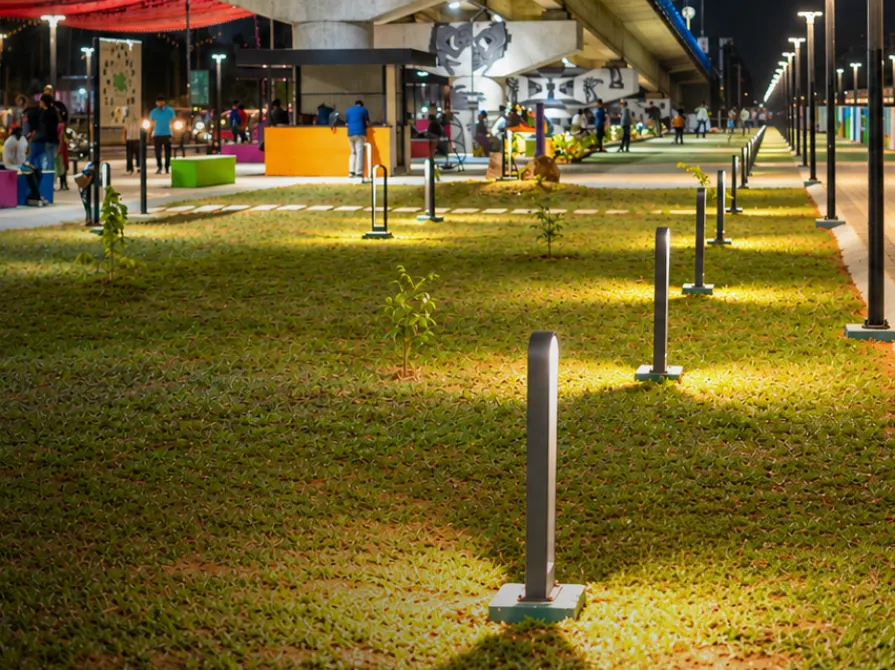


A garden changes character after sunset. The pathways remain the same, the trees occupy the same spaces, and the landscape retains its form—but the way people experience it is determined largely by light.
This is where bollard lighting plays an important role.
Positioned closer to the ground than conventional outdoor luminaires, bollards bring illumination to the pedestrian plane. They can define pathways, reveal changes in level, establish visual boundaries and make movement through gardens more intuitive. But their role goes beyond visibility. When thoughtfully selected and positioned, bollards become an integral part of the landscape itself.
Garden pathways need sufficient illumination for people to navigate comfortably without turning the landscape into an excessively bright environment. Because bollards operate at a relatively low mounting height, their optical distribution can place light where it is actually required—on pathways and surrounding ground surfaces.
Optical control is particularly important here. Wipro Lighting's landscape portfolio, for instance, includes bollards offering symmetric as well as asymmetric light distributions. Symmetric distributions can provide balanced illumination around a luminaire, while asymmetric optics can direct illumination towards pathways and minimise unnecessary spill into adjoining areas.
The result is a landscape that remains comfortably navigable while retaining the contrast, shadow and depth that give gardens their nighttime character.
During the day, a bollard is also a visible architectural element. Its form, scale and placement therefore need to complement pathways, planting, outdoor furniture and the broader design language of the space.
Products such as Wipro Lighting's Quad Bollard combine architectural form with glare-free light distribution, while the Strix Bollard is designed to spread uniform illumination around the ground surface. Such choices allow landscape designers to consider the luminaire not simply as an engineering requirement, but as another element within the composition of the garden.
Gardens are increasingly social spaces—within residential developments, hospitality environments, campuses, parks and public landscapes. Lighting therefore has an experiential role to play.
Rather than illuminating an entire garden uniformly, bollards can establish pockets of light along walking routes and gathering areas. Wipro's Whistling Oyster and Whistling J Bollard, for example, combine controlled pathway illumination with an optional speaker module, integrating light and sound into the outdoor environment.
Good garden lighting is not only about where light falls, but also where it does not.
Uncontrolled upward light, glare and spill can diminish visual comfort and contribute to unnecessary light pollution. Wipro's Utopia landscape philosophy emphasises minimising uplight, glare and unwanted illumination while directing light towards intended areas.
Ultimately, the importance of bollards lies in their ability to perform several roles quietly. They guide without dominating. They improve visibility without demanding excessive illumination. They complement landscape architecture while shaping how it is experienced after dark.
In a well-designed garden, bollards do more than light the path.