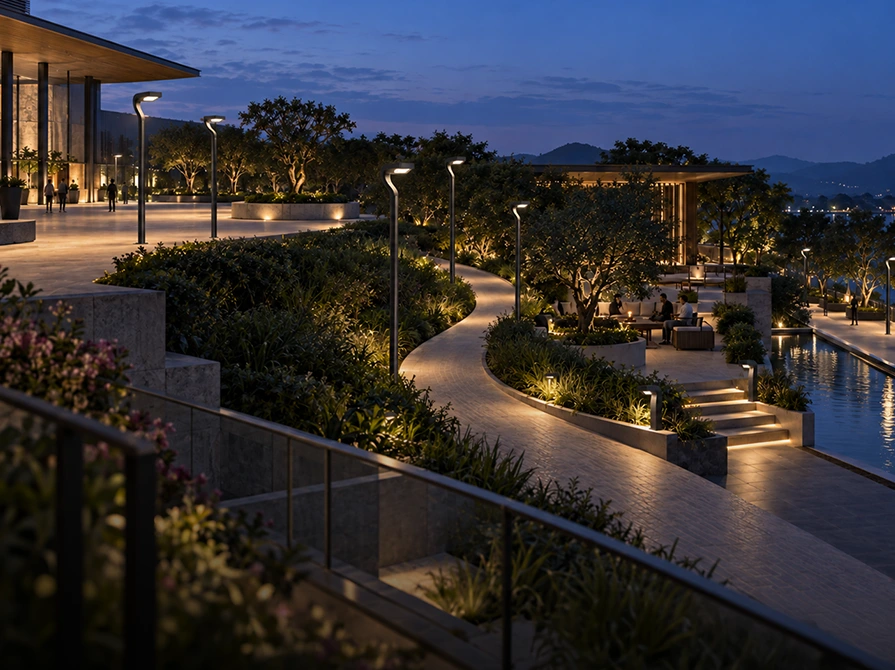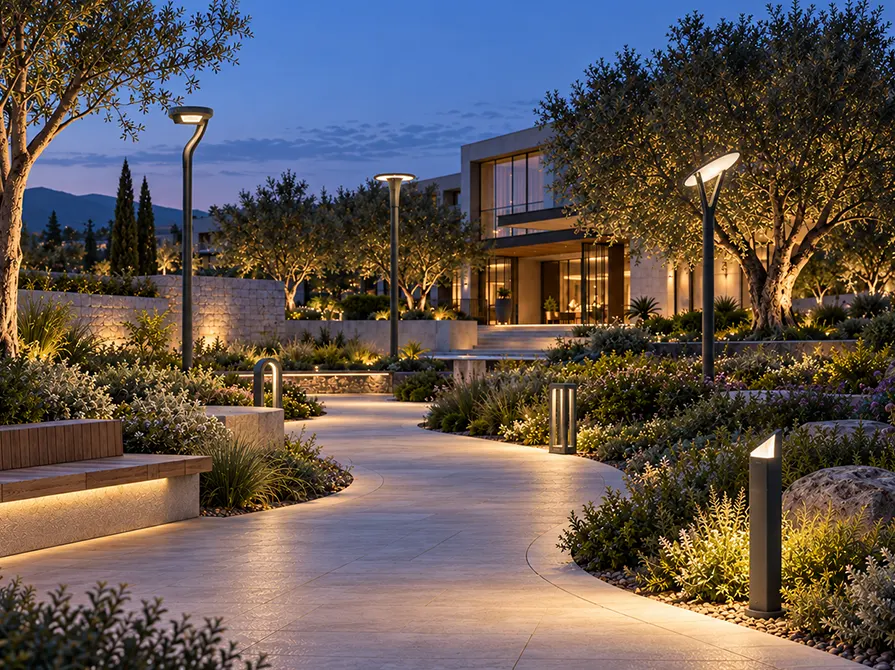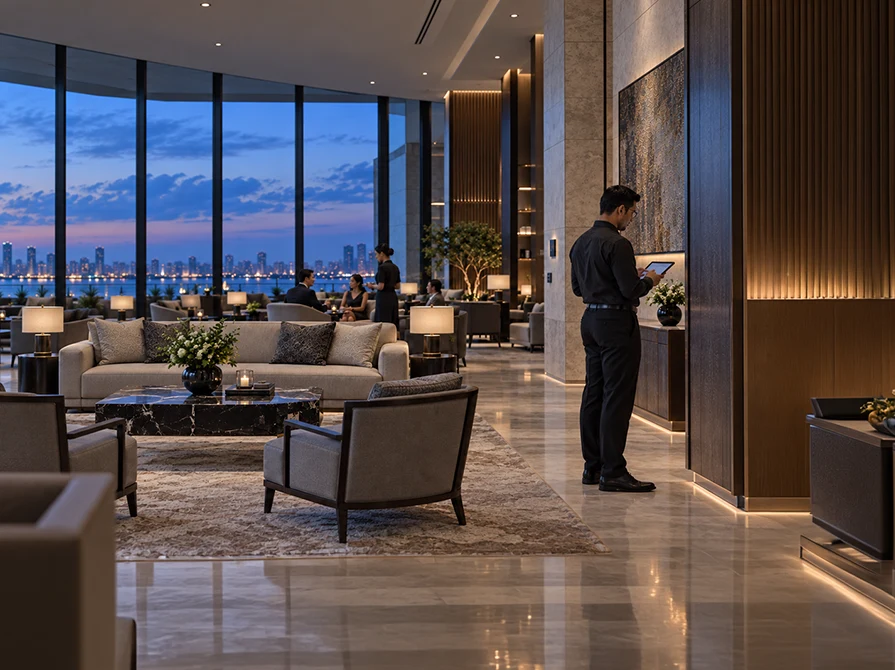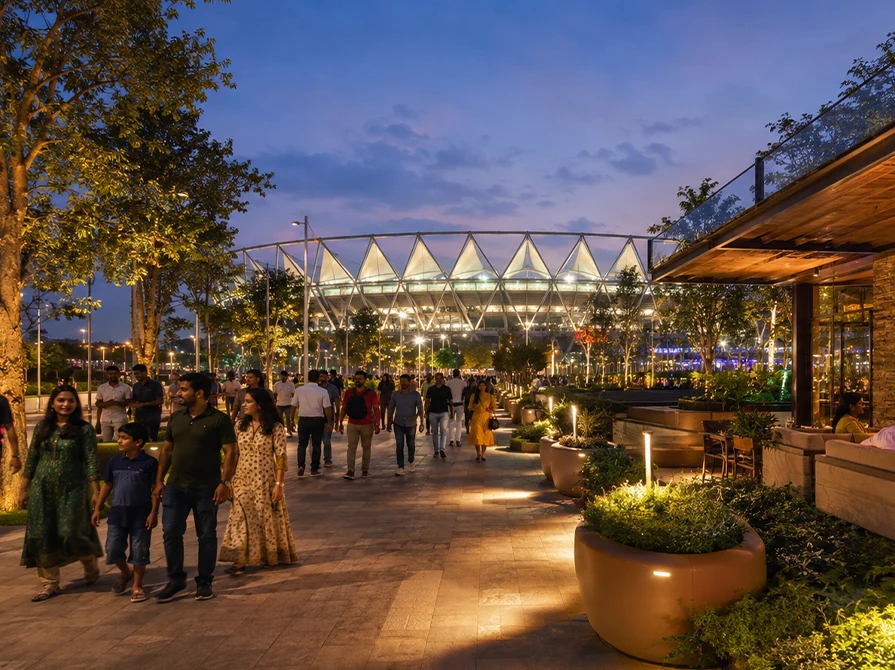


India's commercial and institutional landscape is expanding rapidly, with new office parks, hotels, university campuses, hospitals, retail developments, and large housing societies being built and upgraded across major cities. As these properties grow in scale, the spaces around buildings become an important part of the overall experience.
Outdoor lighting plays a key role across these spaces. It supports safety, security, wayfinding, property aesthetics, and everyday operations while contributing to the visual identity of a development.
For facility managers, architects, MEP consultants, developers, and procurement teams, choosing outdoor lighting involves several considerations, from fixture types and illumination levels to IP ratings, energy efficiency, controls, and maintenance. This guide covers the key aspects of outdoor lighting for commercial properties in India.
Outdoor lighting for commercial spaces refers to lighting systems installed outside buildings and across open areas, pathways, parking zones, perimeters, entrances, and landscaped grounds of offices, hotels, campuses, retail developments, hospitals, and housing societies.
Outdoor lighting helps illuminate pathways, stairs, ramps, parking areas, driveways, and pedestrian crossings. Consistent illumination makes these areas easier to navigate after dark.
Lighting around entrances, boundaries, parking areas, and access points improves visibility for security teams and CCTV systems. A coordinated lighting plan can cover important areas across a property and support safer movement after dark.
The outdoor environment forms part of a visitor's first interaction with a property. Lighting at entrances, facades, pathways, and landscaped areas can create a cohesive arrival experience.
Large campuses and commercial properties often have several entrances, parking areas, blocks, and service zones. Well-positioned outdoor lights help visitors, employees, delivery teams, and vehicles identify the right routes.
Lighting can reinforce the architectural and brand language of a property. Corporate offices may use clean, restrained lighting, while hotels and hospitality properties may use warmer, layered illumination.
Parking areas, loading docks, staff entrances, service yards, and access roads often remain active after sunset. Adequate outdoor lighting supports these activities throughout operating hours.
Outdoor lighting can represent a significant part of the electricity consumption of a large property. Efficient LED fixtures and smart controls can help facility teams manage consumption while maintaining required illumination.
Street and area lights are pole-mounted luminaires used for internal roads, driveways, parking areas, and large open spaces. Their primary functions are safety, visibility, and wayfinding.
Important specifications include lumen output, efficacy, pole height, spacing, beam distribution, and IP rating. For outdoor applications in India, appropriately rated weather protection should form part of the fixture specification.
Flood lights provide high-output illumination across large areas. They can be used for open courtyards, loading docks, sports areas, parking zones, building facades, and other expansive spaces.
Key specifications include wattage, lumen output, beam angle, optical distribution, mounting height, and IP rating.
Bollard lights provide low-level illumination for pedestrian pathways, gardens, landscaped areas, and perimeter zones.
Their height and optical distribution influence pedestrian comfort and light spread. For public-facing applications, impact resistance and appropriate IP protection are important considerations.
Wall-mounted fixtures can provide functional illumination around entrances, corridors, boundary walls, covered walkways, and building exteriors. Up-down fixtures can also contribute to the architectural appearance of a property.
Beam distribution, mounting height, IP rating, and light output should be selected according to the application.
Wall washers provide broad illumination across facades, while focus lights create targeted accents on architectural features and landscaping.
Beam angle, throw distance, CRI, lumen output, and IP rating are important specifications when using these fixtures for outdoor architectural lighting.
Landscape lighting covers parks, lawns, gardens, pathways, and green areas within commercial campuses and residential developments.
Applications include path lights, in-ground uplighters, tree-mounted spotlights, and low-level landscape fixtures. The objective is to create comfortable illumination while complementing the surrounding architecture and landscape.
Canopy and soffit lights are installed under covered entrances, parking structures, building overhangs, and similar semi-outdoor areas.
They can provide functional illumination for drop-off zones, pedestrian areas, and covered parking. The IP rating should match the degree of exposure at the installation location.
Solar-powered LED fixtures can be useful for locations where grid connectivity is limited or cable trenching is difficult. Large campuses can use them for remote pathways, outer perimeters, parking overflow areas, and other suitable zones.
The design should account for solar generation, battery capacity, operating hours, seasonal conditions, and required illumination.
Office campuses typically require lighting across parking areas, building entrances, pedestrian pathways, internal roads, loading docks, and perimeters.
A professional and functional lighting approach can combine street lights for roads and parking, bollards for pathways, wall lights around entrances, and architectural lighting for building facades.
Hotels and resorts use outdoor lighting to combine function with ambience. Key areas include the entrance and porte-cochère, pathways, gardens, pool perimeters, parking, and building facades.
Educational campuses typically cover large areas with academic buildings, hostels, sports facilities, parking areas, pathways, and administrative blocks.
Lighting priorities include pedestrian safety, campus navigation, building entrances, perimeter security, and sports areas. Efficient LED fixtures and scheduled controls can help manage energy use across the large footprint.
Residential developments require lighting for entrance gates, internal roads, parking areas, gardens, clubhouses, pathways, and children's play areas.
Street lights can cover internal roads, while bollards and landscape fixtures can illuminate pedestrian areas. Wall-mounted fixtures and flood lights can support entrances and perimeter areas.
Hospitals require clear and reliable illumination around main entrances, emergency access points, parking areas, staff entrances, pathways, and building perimeters.
Lighting should support wayfinding and comfortable movement for patients, visitors, staff, and emergency teams. LED technology provides instant-on operation and consistent illumination across critical access areas.
Retail and mixed-use properties often operate into late evening hours and require high visibility around entrances, parking areas, common spaces, signage, and service zones. Facade lighting, flood lights, canopy lights, and area lighting can work together to create a clear and commercially engaging exterior environment.
Industrial and logistics facilities typically require high-output lighting around perimeters, warehouses, loading docks, storage areas, parking, and access roads. Durability, IP protection, appropriate illumination levels, and reliable operation are key considerations, particularly across large outdoor areas.
Outdoor lighting fixtures are exposed to dust, rain, humidity, heat, and seasonal weather conditions. IP ratings indicate the level of protection provided by an enclosure against solid particles and water.
Common ratings include:
Ground-level fixtures, water features, and flood-prone areas require careful consideration of IP protection.
LED technology has become a preferred solution for commercial outdoor lighting because of its energy efficiency, long operating life, controllability, and instant-on performance.
Compared with conventional sodium vapour and metal halide systems, LED outdoor lighting can provide:
For large properties with hundreds of outdoor fixtures, these characteristics can have a meaningful impact on energy consumption and maintenance planning.
Smart controls allow facility teams to manage outdoor lighting according to time, occupancy, ambient conditions, and operational requirements.
These controls use local sunrise and sunset information to automate switching schedules. This helps align operating hours with actual daylight conditions.
Sensors can reduce lighting levels in low-traffic areas and restore the required output when movement is detected. This can be useful for parking areas, pathways, service roads, and peripheral zones.
Ambient light sensors can adjust lighting output during dusk and dawn, when natural light levels change gradually.
Facility managers can monitor the status of outdoor fixtures through a central dashboard. Connected systems can provide alerts for faults and help teams identify maintenance requirements.
Smart systems can provide consumption data by zone and operating period. This data can support energy management and sustainability reporting.
Outdoor lighting can be scheduled at different output levels throughout the night according to footfall and operational requirements.
Outdoor lighting can be integrated into the property's Building Management System, allowing facility teams to coordinate lighting with broader building operations.
Outdoor lighting design increasingly forms part of a property's wider sustainability strategy. Green building frameworks such as LEED, IGBC, and GRIHA include energy efficiency considerations that can influence lighting design.
Key areas to evaluate include:
Outdoor fixtures should have protection appropriate to their installation environment, particularly in coastal and heavy-rainfall locations.
Parking areas and pathways benefit from consistent illumination. Fixture spacing, mounting height, optics, and lumen output should be evaluated together.
Timers, sensors, dimming, and smart schedules can align illumination with actual usage patterns.
Lumen maintenance, rated life, energy efficiency, warranty, service support, and replacement requirements all contribute to lifecycle cost.
Outdoor lighting requires electrical infrastructure, foundations, cable routes, control panels, and maintenance access. These should be considered during the initial site planning stage.
Fixtures should be positioned so that routine inspection, cleaning, and replacement can be carried out safely and efficiently.
A complete outdoor lighting plan should cover entrances, side and rear areas, pathways, parking, service zones, and perimeters according to the property's requirements.
Before finalising an outdoor lighting system, define:
A clear specification helps consultants and procurement teams compare products based on performance and lifecycle value.
What is outdoor lighting for commercial spaces?
Outdoor lighting for commercial spaces refers to lighting systems installed outside offices, hotels, campuses, hospitals, retail developments, and housing societies. It provides illumination across parking areas, pathways, entrances, facades, perimeters, landscaped areas, and other outdoor zones to support safety, security, wayfinding, operations, and aesthetics.
What type of outdoor lights are used in commercial properties in India?
Common options include street and area lights for roads and parking, flood lights for large areas, bollards for pathways, wall-mounted fixtures for entrances and exteriors, wall washers and focus lights for architectural features, canopy lights for covered areas, and solar lights for suitable remote or off-grid zones.
What IP rating is required for outdoor lights in India?
IP65 is a common baseline for outdoor lighting applications. IP66 can be considered for coastal cities and locations with heavy monsoon exposure. In-ground applications and locations with greater water exposure may require IP67 or IP68, depending on the installation conditions and manufacturer's specifications.
How much energy can LED outdoor lights save for commercial properties?
LED outdoor lighting can deliver approximately 50% to 70% energy savings compared with suitable conventional lighting systems. Smart controls such as sensors, astronomical timers, and dimming schedules can provide additional savings by aligning lighting output with actual operating requirements.
What is the best outdoor light for a housing society in India?
A typical housing society lighting plan can combine LED street lights for internal roads, bollards for pathways and gardens, wall-mounted fixtures for building exteriors, and flood lights for entrances and larger open areas. Smart controls can be used in parking and low-footfall areas to manage operating hours and energy consumption.
Can outdoor lighting be automated for a large commercial campus?
Yes. Modern outdoor LED systems can integrate astronomical scheduling, motion sensors, dimming, centralised monitoring, energy reporting, and BMS integration. These capabilities are particularly useful for large campuses with multiple buildings and hundreds of outdoor fixtures.
How long do commercial outdoor LED lights last?
Many high-quality commercial LED fixtures have rated lifespans of 50,000 hours or more. At 10 to 12 hours of operation per night, 50,000 hours represents approximately 11 to 14 years of operating time. Actual service life depends on operating conditions, thermal management, environmental exposure, maintenance, and product specifications.
What should I look for when buying outdoor LED lights for a commercial property?
Key specifications include IP rating, lumen output, efficacy, CRI, colour temperature, beam distribution, mounting requirements, dimming compatibility, smart control compatibility, rated life, warranty, and after-sales service. The right specifications should be determined according to the intended application and site conditions.
From office campuses and hotels to housing societies, hospitals, educational institutions, retail developments, and industrial parks, each property requires a lighting strategy based on its spaces, users, operating hours, architecture, and environmental conditions.
Wipro Lighting offers outdoor lighting solutions across street lighting, flood lighting, bollards, architectural applications, solar lighting, and smart outdoor lighting.
Get in touch today for a site-specific outdoor lighting plan tailored to your property.