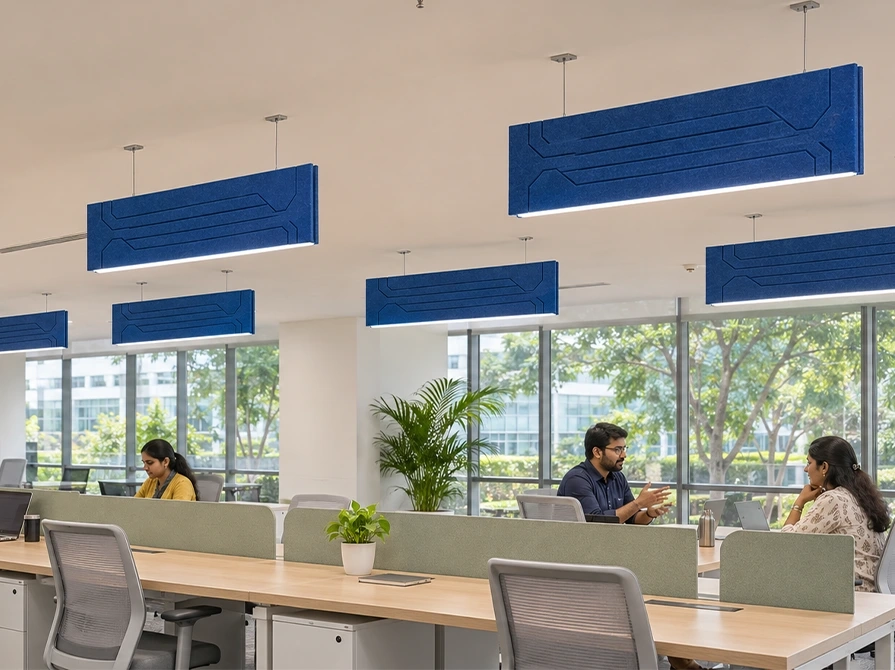
Acoustic lighting combines functional illumination with sound-absorbing materials in a single fixture. It helps manage reflected sound and reverberation in offices by absorbing some of the sound that would otherwise bounce between hard surfaces. Unlike conventional lighting, acoustic light fixtures can contribute to both visual comfort and the acoustic performance of a workspace.
As open-plan offices, IT campuses, BPO centres and coworking spaces continue to shape India's commercial workplaces, managing noise has become an important part of office design. Conversations, phone calls and collaborative activities can compete with tasks requiring concentration. Acoustic lighting offers a way to address part of this challenge while integrating lighting and acoustic treatment into the same ceiling installation.
Acoustic lighting works by combining a light source with sound-absorbing material. The lighting component illuminates the workspace, while the acoustic component absorbs a portion of the sound energy that reaches it.
Understanding three acoustic terms helps explain how it works.
Sound absorption reduces reflected sound within a room. Materials such as acoustic felt and specialised porous panels absorb some sound energy, helping control echoes and reverberation.
Soundproofing addresses the transmission of sound between spaces. It typically involves elements such as walls, doors, glazing and floor-ceiling assemblies. Acoustic lighting can contribute to sound absorption, but it does not replace sound insulation or provide acoustic privacy on its own.
RT60 is the time required for sound energy in a space to decay by 60 decibels after the sound source stops. A long reverberation time can make speech sound less clear and cause conversations to overlap perceptually.
Open-plan offices generally benefit from controlling reverberation, but the appropriate target depends on room volume, occupancy, activities and acoustic design requirements. A single RT60 target is not suitable for every workplace.
The Noise Reduction Coefficient (NRC) is a rating used to describe a material's sound absorption performance, expressed on a scale from 0 to 1 in its conventional form. A rating closer to 1 indicates greater sound absorption across the frequencies included in the rating.
NRC values must be checked for the specific acoustic product. Acoustic lighting fixtures vary in their materials, geometry and exposed absorption area, so a rating from one panel cannot automatically be applied to another fixture.
A related measurement is the sabin, a unit of sound absorption. One square metre sabin represents the sound absorption equivalent of one square metre of perfectly absorbing surface under the relevant measurement convention.
An acoustic lighting fixture integrates an LED lighting system with sound-absorbing material. Its design must accommodate optical performance, acoustic absorption, heat management, electrical components, and mounting requirements.
Common construction elements include:
Acoustic materials may include PET felt, mineral wool or specialised acoustic foams. Their performance depends on thickness, density, construction, exposed surface area and installation. Fire performance, durability, cleaning requirements and indoor air quality should also be considered when selecting materials for commercial interiors.
Wipro Lighting's Hexa acoustic lighting range combines pendant lighting with acoustic functionality. The official product page lists 600 mm and 800 mm sizes, rated at 30 W and 40 W respectively, with 3000K, 4000K and 5700K colour temperature options.
Wipro also lists a sound absorption value of 0.51 m² sabin and a 43% RT60 reduction figure for the acoustic solution. These are product-specific published figures, not universal performance values for acoustic lighting. The actual acoustic outcome will depend on the number and arrangement of fixtures, room dimensions, existing finishes and other sound-absorbing surfaces.
Product specifications should be confirmed against the latest datasheet and the proposed installation before finalising a project.
Acoustic lighting is particularly relevant to workplaces where multiple activities take place within the same open environment.
Technology offices often combine collaborative areas, individual workstations, meeting zones, and informal discussion spaces. Sound-absorbing lighting can complement ceiling panels and other acoustic treatments while maintaining a coordinated ceiling design.
BPO environments involve frequent calls and simultaneous conversations. Acoustic lighting can help reduce reverberation, making the overall sound environment more controlled. However, call-centre noise also requires consideration of workstation layouts, acoustic screens, sound isolation and, where appropriate, sound masking.
Coworking environments bring together teams with different working styles. A space may need to accommodate meetings, focused work and informal discussions throughout the day. Acoustic lighting can contribute to acoustic treatment without introducing a separate ceiling-mounted panel system.
Hybrid workplaces may alternate between quiet periods and busy collaboration sessions. Lighting controls can support different illumination needs, while acoustic treatment remains useful throughout occupancy changes. Empty or lightly occupied rooms may sound more reverberant because people and furnishings absorb less sound than a fully occupied space.
For Indian commercial projects, acoustic lighting should be treated as one element of a broader workplace design strategy. Its effectiveness depends on the room's acoustic characteristics and how people use the space.
Acoustic lighting is most useful when a project needs both illumination and sound absorption. Other solutions may provide more extensive acoustic coverage or address different problems.
| Solution | Primary function | Lighting integration | Best suited for |
|---|---|---|---|
| Acoustic lighting | Combines illumination and sound absorption | Integrated | Offices, collaboration areas and shared workspaces |
| Standalone acoustic ceiling panels | Absorb reflected sound over a broad ceiling area | Separate lighting required | Large open-plan offices and meeting areas |
| Acoustic baffles | Provide additional sound-absorbing surfaces suspended from the ceiling | Separate lighting or integrated options | High ceilings and large commercial interiors |
| Acoustic furniture and desk screens | Help absorb sound and interrupt direct sound paths | Usually separate | Workstations, focus areas and collaborative zones |
Acoustic lighting can simplify coordination between lighting and acoustic elements, particularly where ceiling space is limited. However, it should not automatically be considered cheaper than separate systems. The total cost depends on fixture quantity, acoustic performance, installation, controls and the extent of additional treatment required.
For large or noisy offices, a combined strategy using acoustic lighting, ceiling treatments, screens and suitable room planning may deliver better results than relying on any one solution.
Green building and healthy workplace frameworks consider indoor environmental quality, including aspects of lighting and acoustic comfort. Acoustic lighting may support relevant design objectives, but installing the product alone does not establish certification compliance.
WELL v2 includes sound-related features addressing reverberation time and sound-reducing surfaces. Acoustic lighting may contribute to the sound absorption strategy where its documented performance and installation meet the relevant requirements. Lighting performance is assessed separately under applicable light-related features.
LEED includes acoustic performance requirements or credits in applicable rating systems. Depending on the project and rating pathway, these can address issues such as background noise, sound transmission, and reverberation time. Acoustic lighting may contribute to the reverberation component, but the project team must demonstrate compliance with the relevant criteria.
India's GRIHA rating system addresses indoor environmental quality and acoustic comfort. Its criteria include measures for managing indoor noise and using appropriate acoustic controls. Acoustic lighting may form part of the wider design strategy when supported by the required documentation and project assessment.
For all three frameworks, review the applicable rating version, credit requirements, and evidence needed before specifying a product for certification purposes.
When evaluating acoustic lighting for an Indian commercial project, consider these factors:
A lighting layout and an acoustic assessment should be coordinated early in the design process. This allows the project team to evaluate the combined effect of fixture placement, acoustic coverage and illumination before installation.
Acoustic lighting combines a light source with sound-absorbing material. It illuminates a room while absorbing some reflected sound, helping manage reverberation when appropriately designed and installed.
NRC is a rating of sound absorption on a conventional scale from 0 to 1. The relevant value depends on the specific product and its tested construction, so request the manufacturer's acoustic performance data.
There is no universal noise-reduction figure for acoustic lighting. Its impact depends on the fixture's absorption performance, the number of units installed, room volume, surface finishes, and other acoustic treatments. Sound absorption can reduce reverberation, but it does not independently soundproof a room.
It can be useful in BPO and IT environments where conversations and calls take place in shared spaces. For best results, combine acoustic lighting with suitable workstation layouts, acoustic screens, and other measures matched to the source of the noise.
RT60 measures how long sound takes to decay by 60 decibels after the source stops. Acoustic lighting can contribute to lowering reverberation when the installed fixtures provide sufficient sound absorption for the room.
Acoustic lighting may contribute to the sound absorption strategy for relevant WELL requirements when its performance and installation meet the applicable criteria. Certification depends on the complete project and its documentation, not on the use of a particular product alone.
Acoustic lighting combines two workplace design functions in one fixture: illumination and sound absorption. For Indian offices, IT campuses, BPO centres and coworking spaces, it can help manage reverberation while supporting a coordinated ceiling design.
The right solution depends on the space, the required lighting performance, and the acoustic outcome the project aims to achieve. Explore Wipro acoustic lighting for offices and read our acoustic light fixtures buying guide for Indian offices to evaluate the options for your workplace. Get in touch with our team for more details.